Agency SOPs work best in order: client onboarding, weekly status, handoffs, then your definition of done. Here's what a small agency should document first.
Last updated: November 5, 2026
One of my early clients had nothing written down. No SOPs. No shared doc. Every process lived in the founder's head, and I was handed tasks like a VA with nowhere to put them.
So I stopped doing tasks and built the system. The first thing I wrote down was never what the founder thought mattered most. It was whatever broke most often.
That's still the rule. Your first agency SOPs (standard operating procedures) cover what your clients feel every week. Onboarding and expectations setting. Client fulfillment. Status updates. Handoffs. Your definition of done and accountability.
The org chart can wait. So can the brand guidelines.
Why is it so hard for a small agency to document anything?
Because the person who knows how everything works is also the person with the least time to write it down.
In a small agency, the process lives in the founder's head, or in the head of the one account manager who has been there longest. Writing it down feels like a project. Projects need time. Time goes to client work. So the documentation sits on a someday list for a year.
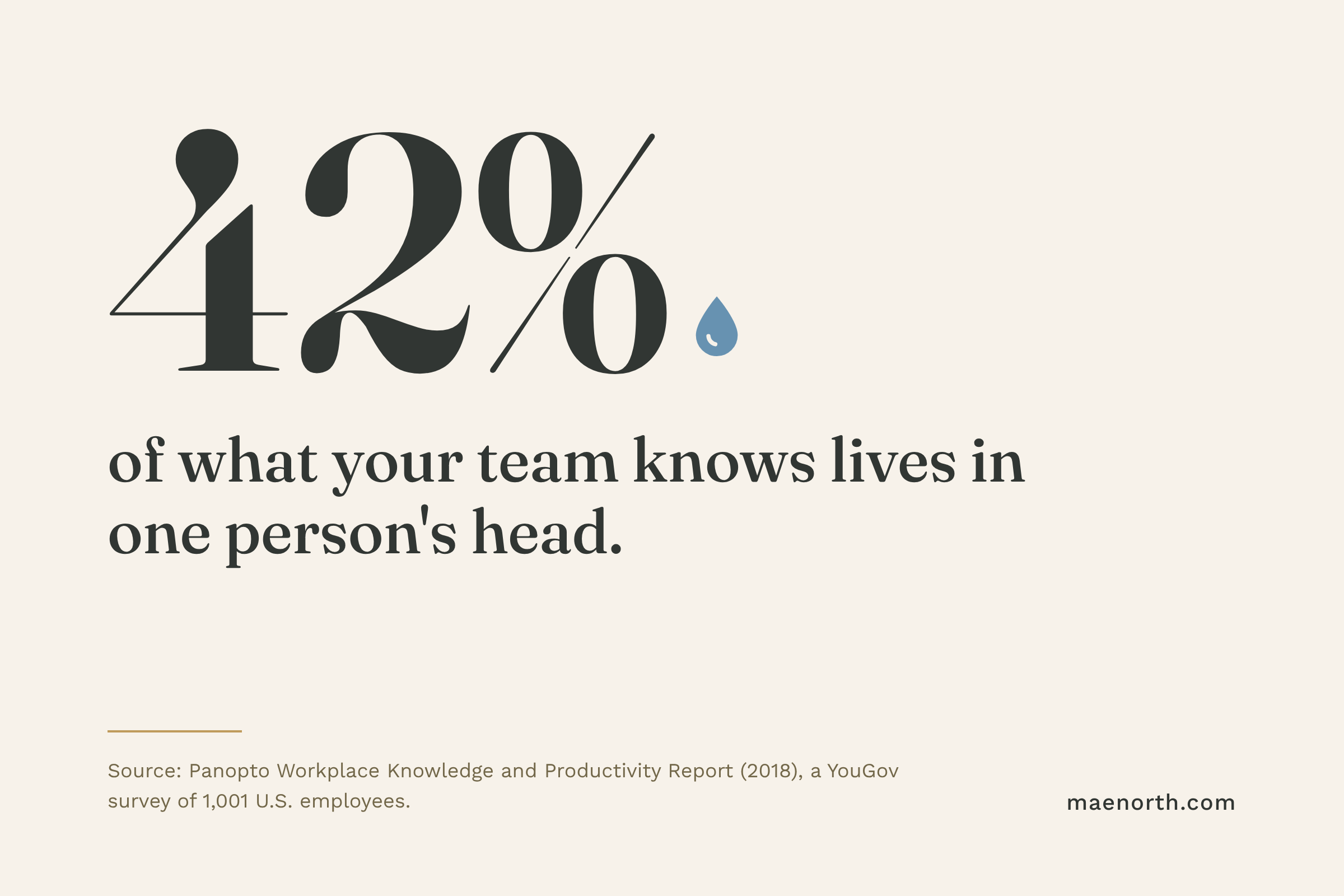
That isn't unique to agencies. A YouGov survey of 1,001 U.S. employees, workers said 42% of the knowledge they use in their role is unique to them. No one else on the team holds it.
42%. Read that number again. My ops brain is crying right now.
There's a second reason, and it's quieter. Most owners try to document everything at once. They open a blank doc called "Operations Manual or [Business Name] HQ" stare at it, and close it. The scope is the problem, not the discipline. This is a necessary document—but it's living and someone needs to own it when it changes or it can become outdated very quickly.
This isn't a character flaw of the founder or top account manager. It's an operations problem. And operations are fixable.
What should a small agency document first?
Start with the processes that touch the client and repeat often. When those break, the client notices, and you end up fixing it yourself at 9 p.m. That's the cost you're trying to stop paying.
If you don't want your business to stall whether you are sick, lose a team member, or simply want to go on a vacation.
| Process | How often it runs | Who feels it when it breaks | Where it goes on your list |
|---|---|---|---|
| Client onboarding | Every new client | The client, on day one | First |
| Weekly status update | Every week | The client | Second |
| Handoffs between people | Every deliverable | Your team, then the client | Third |
| Definition of done | Every deliverable | Your team, then the client | Fourth |
| Team onboarding, time tracking, invoicing | Each hire or each month | Mostly your team | Next |
| Scope changes, unhappy clients | When they come up | The client, at high stakes | Once the normal path is written |
1. Client onboarding
Onboarding is the first promise you keep or break. It's also the process most agencies run differently every single time.
Those differences cost you later. A survey of agency owners, 24% named misaligned expectations at onboarding as a top reason clients leave. This is connected to performance not meeting expectations and lack of perceived value over time.
Write down what happens between "contract signed" and "first deliverable." Who sends the welcome email. What you need from the client and by when. Which accounts and logins you request. When the kickoff call happens and what it covers. Who owns the client from day one. And the most important: what does success look like for the client. That is your North Star for this account.
If you only document one thing this quarter, make it this one. Setting up a solid onboarding list in your New Client Template Folder or wherever you have your onboarding list will set you and your clients up for success. It decides whether new people, and new clients, succeed. And it ensures you're not getting in the way.
2. Your weekly status rhythm
How does a client know where their work stands? If the honest answer is "they email and ask," that's your second SOP.
Decide what goes out, on what day, from whom, and in what format. A short weekly update. A shared board. A standing call. It doesn't matter which, as long as it's the same every week and someone other than you can send it.
This one pays you back fast. A predictable update cuts the "just checking in" emails that pull you into every account. It's why I send every client a recap at the end of each week with a dashboard showing them where their work stands.
Communication is what keeps clients, too. In the above mentioned report, 69% of agencies ranked effective communication as a top retention factor, second only to strong relationships at 80%.
3. Handoffs between people
Most delivery problems don't happen inside a task. They happen between tasks. The writer finishes, and the editor doesn't know. The designer exports the file, and it sits in a folder nobody checks.
Those gaps add up. When team members wait on information from colleagues in Slack, email, Voxer or whatever tool, you lose time and you're likely going to miss promised expectations to clients.
Map every point where work passes from one person to another. For each one, write down three things: what "ready to hand off" means, where the work goes, and how the next person finds out.
Write these around roles, not names. People change. Contractors come and go. A handoff that says "Editor reviews within two business days" tied to a gantt chart or a task or an automated alert survives a staffing change. One that says "Send it to Sam" doesn't.
4. Your definition of done
A definition of done is the written checklist that says a deliverable is actually finished. What does finished look like for each one? A blog post might need a proofread, a link check and an approved meta description. A campaign report might need the numbers checked against the platform before it goes out.
The term comes from Scrum, the agile framework many software teams run on. This approach treats it as a formal quality bar, so everyone shares one understanding of what "complete" means.
Without a written definition of done, "done" means "done the way the founder would have done it." That's how good people start to look like they're failing. They never got the checklist that lived in your head.
Unclear expectations reach well beyond agencies. Gallup found that fewer than half of U.S. employees strongly agreed they knew what was expected of them at work in the first half of 2026, and that share fell again in the third quarter.
5. Then everything else
Once your first four SOPs are written and in use, move to internal operations: team onboarding, time tracking, invoicing. Then the edge cases, like scope changes and unhappy clients.
Edge cases matter. But you'll write better edge-case SOPs once the normal path is documented, because you'll be able to see exactly where the normal path bends.
How do you decide what to document next?
Ask three questions about any process on your list. How often does it happen? How bad is it when it goes wrong? How much does it hurt right now?
A process that runs every week, touches the client, and has gone wrong in the last month goes to the top. A process that runs once a year and has never caused a problem goes to the bottom, even if it feels important.
This week, I worked with an agency client that was having a hard time deciding what the "definition of done" meant for certain client deliverables. In the end, we decided client deliverables were done when they were published live on a blog or LinkedIn. This gave the team more clarity on how to use the statuses in their project management tool, and now they are working consistently and communicating better with clients.
How detailed should an SOP be?
Short enough to use while you're doing the task. If someone has to stop working to read it, it's too long.
Keep it short, give it one named delivery role (like content editor) on it, a time estimate and put a last-updated date on it.
I'd add one thing. Write the first draft by doing the task and noting each step as you go, not by remembering it at your desk. Memory skips the steps you do on autopilot, and those are exactly the steps a new person misses.
A good first SOP fits on one screen. A checklist, a few notes on judgment calls, and a link to any template. You can add detail when someone gets stuck. Their questions tell you where the gaps are.
Where should your SOPs live?
Where the work lives. If your team manages delivery in ClickUp, put the SOP in a ClickUp task, not in a Google Drive folder three clicks away.
ClickUp itself describes the pieces: Docs for briefs and SOPs, saved project templates with statuses and assignees, default task templates for work that repeats, and recurring tasks for routine delivery.
Used together, the onboarding SOP becomes a project template. Every new client starts from it. Nobody has to remember the steps, because the steps show up as tasks.
I ran operations at Beam Content, the content marketing agency I co-founded, through a full ClickUp implementation, and I've since built ClickUp workspaces for client businesses.
That's the real test of documentation. Not whether it exists, but whether it shows up at the moment someone needs it.
Should you automate the process right away?
No. Automate it after it's stable.
ClickUp lists "automating a workflow that is not stable yet" as a common setup mistake, and I see why. If you automate a process you're still changing every month, you end up maintaining the automation instead of fixing the process.
Run the written process by hand for a few cycles. Watch where people get stuck. Fix it. Then automate the parts that stay the same every time.
FAQs: Agency SOPs
Q: What is an agency SOP?
A: An agency SOP, or standard operating procedure, is the written set of steps for a job your agency repeats, like onboarding a client or sending a weekly update. A good one fits on one screen, names one owner and shows when it was last updated.
Q: How many SOPs does a small agency need?
A: Fewer than you think to start. Four well-used SOPs (onboarding, weekly status, handoffs and definition of done) will do more for you than forty that nobody opens. Add the next one when another process keeps pulling you back into the work.
Q: Who should write the SOPs?
A: An ops leader who has interviewed the person who does the work, with someone else testing it. The doer knows the steps. A second person following the doc for the first time finds the gaps. Write the draft while doing the task, so the steps you do on autopilot make it onto the page.
Q: How often should you update an SOP?
A: When the process changes, not on a calendar. Give each SOP one owner, and make updating it part of changing the process. A visible last-updated date at the top tells your team at a glance whether the SOP can still be trusted.
Q: Should SOPs be written around people or roles?
A: Roles. Write "Account lead sends the weekly update," not a person's name. Your documentation should survive a team change, including the contractors and part-time help who come and go. When someone new steps into the role, the SOP already fits them.
Start with the one that breaks most
You don't need an operations manual. You need the one process that keeps pulling you back into the work, written down well enough that someone else can run it.
Then the next one. Then the next.
That's how a business stops depending on one person's memory. Not in one big push, but one documented process at a time. If you want to see what that looks like as a full role, here's how I work as Fractional Director of Operations.
And if you'd like help deciding where to start, a Strategic Mapping Session is built for exactly that: a twelve-month plan and a ninety-day board you can work from.
Schedule a Discovery Call to learn more about how I could help you with SOPs and your Operations.

Get the best strategies delivered
Join other business owners who are cutting through the noise and building better operations.
Ready to simplify your operations?
See how other six-figure business owners transformed their workflows and profits.